


B2B and OEM companies are built to evolve. Acquisitions expand capability. Divestitures sharpen focus. Reorganizations improve how work gets done. Leadership changes signal new priorities. Portfolio shifts help companies meet changing market needs.
These moves may be necessary to advance the business. But the market does not experience them as an internal strategy. Customers, employees, channel partners and sales teams experience them through the story the company tells — or fails to tell.
When that story is unclear, business transformation can quickly become brand confusion.
Customers may wonder what the company stands for now. Sales teams may struggle to explain the change consistently. Channel partners may question which brands, products or messages to lead with. Employees may lose confidence in how to describe the organization. And competitors may use uncertainty to define the narrative for you.
Change is inevitable. Brand confusion does not have to be.
The Risk Isn’t Change. It’s a Fragmented Story.
For OEMs, complexity is already part of the environment. Multiple product lines, technical audiences, distributor relationships, long sales cycles and layered buying committees make clarity difficult even in stable conditions. Add a major business change, and the risk of fragmentation increases.
One team may talk about the acquisition as a growth story. Another may frame it as an innovation story. Sales may focus on new capabilities. Customer service may reassure buyers that nothing changes. The website may still reflect the old structure. Product naming may lag behind the business reality.
None of these messages may be wrong. But if they are not connected, the market receives pieces instead of a story.
That is where brand strategy matters. Brand is not simply a logo, a campaign or a set of guidelines. In moments of change, brands become the organizing idea that helps people understand who the company is, what it stands for, what it offers and where it is going.
Don’t Just Tell the Market What Happened
One of the most common mistakes companies make during transformation is focusing too heavily on the event itself.

Those statements explain what happened. They do not necessarily explain what it means.
The more important question for the market is: Why should I believe this makes the company stronger, clearer or more valuable to me?
A strong brand narrative connects internal change to external relevance. It explains why the business is evolving, how the change supports the company’s direction and what customers can continue to count on. It gives sales, marketing, leadership and channel teams a shared language for the transition.
The goal is not to make change invisible. It is to make change make sense.
Know What Should Change — and What Shouldn’t
Brand consistency does not mean standing still. Companies can change their structure, leadership, product architecture, capabilities, markets and visual expression without abandoning the core beliefs and promises that made them credible in the first place.
The work is knowing what should evolve and what must remain constant.
For OEM brands, that often means clarifying:
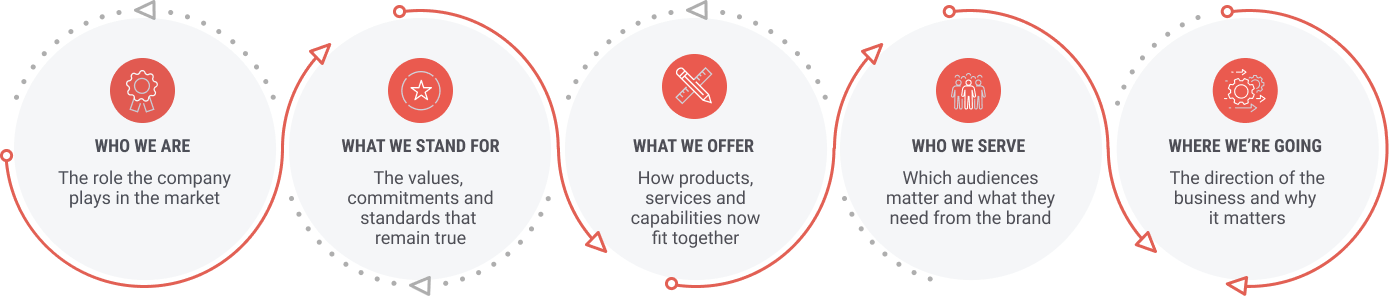
This is how brand becomes a bridge between what was and what will be.
Make Brand Clarity Operational
A clear narrative only works if it shows consistently across the business. That means brand strategy has to move beyond messaging and into the customer experience.
Before, during and after a major change, OEM marketers should align:
- Leadership messaging so the business direction is clear
- Sales enablement so teams can explain the change with confidence
- Portfolio architecture so offerings are easy to understand
- Digital experiences so websites and tools reflect the current business
- Channel communications so partners know what to say and sell
- Customer-facing content so different audiences get the answers they need
Different stakeholders will experience the same change in different ways. A distributor may need clarity on products and ordering. A strategic account may need reassurance about continuity. An engineer may need technical documentation. An employee may need language that helps them believe in and explain the future.
Brand clarity gives each audience the right version of the same story.
Clarity Creates Confidence
In periods of change, silence creates space for uncertainty. Disconnected messages create friction. A clear brand story creates confidence.
The strongest OEM brands do not simply announce transformation. They use it as a moment to reinforce why they matter.
They tell the market where they are going, not just what happened. They protect the promises that earned trust while giving the business room to evolve. They make it easier for customers, employees and partners to understand the change and believe in the direction.
Because successful transformation is not only about changing the business.
It is about helping the market understand why the brand is stronger because of it.