

Marketing is the generator that powers strategy, product development and pricing. Communications is the conduit, connecting content, channels and storytelling.
There has been a long-standing debate about marketing versus sales. The issue may lie in how this debate is usually framed: as a “versus” situation. However, this framing or narrative creates a false choice. If we instead think of it as marketing “and” sales, we start to see how these two teams together can drive a company’s growth.
They’re gears in the same growth engine. Marketing’s role isn’t to replace sales; rather, it’s a force multiplier that supports sales and helps reduce risk throughout the buyer’s journey from the top of the funnel to the bottom. This is especially true in complex B2B and OEM environments, where sales cycles are longer, and multiple stakeholders and technical risk are the norm. Which then begs the question, how do B2B companies manage the sales funnel, and what role does marketing play in the equation?
To do this, it helps to have a definition of marketing, not to be confused with marketing communications, which we’ll also discuss, and which is also an “and” situation, not a “versus” one. Like sales, these two disciplines also need to work closely together to optimize go-to-market strategies and increase the velocity of movement through the sales funnel.

The Roles of Marketing and Marketing Communications
Admittedly, many companies use marketing and marketing communications interchangeably. By some definitions, marketing is responsible for creating awareness, building brand recognition and nurturing leads through content, campaigns and experiences. Some might argue that this is actually the definition of marketing communications, whereas marketing supports product development, identifies market opportunities, conducts competitor analysis, codifies value propositions and is involved in pricing, among other critical tasks. When defining marketing, the devil is in the details.
At Crafted, our view is that marketing is the generator that powers strategy, product development and pricing; marketing communications is the conduit, connecting content, channels and relevant storytelling that scratches an itch. You need both to attract customers, convert sales and retain customers — especially in OEM and manufacturing environments, where differentiation, credibility and trust are earned over time.

Full-Funnel Marketing and the Decision-Making Process
With that in mind, let's look at the full-funnel approach with fresh eyes. The concept of full-funnel marketing typically breaks down into the top of the funnel, the mid-funnel and the bottom of the funnel. The funnel approach adds structure to operationalize marketing and sales activities that align with the steps in the buyer decision-making process, which include:
- Problem recognition: Realizing a need or problem
- Information search: Gathering information about potential solutions
- Alternatives evaluation: Comparing different options
- Purchase decision: Making the actual purchase
- Post-purchase evaluation: Reflecting on the purchasing decision and considering what’s next
Both branding and performance marketing efforts play a role across this decision-making continuum; the common component is content. The type of content that is developed and applied in a full-funnel model is designed to accelerate the velocity of the process by helping reduce friction — shaping perceptions, building credibility and establishing trust as a meaningful differentiator.
When designing a content marketing program, you must also account for the reality that, in most cases, you're engaging a complex matrix within an equally complex organization with a diverse buying group involved in the decision-making process. This makes having the right content for the right audience at the right time more than just important. It’s essential.

Aligning Content To Accelerate the Customer Journey
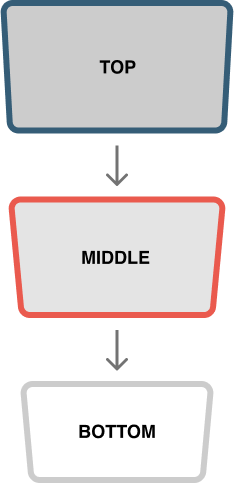
Top of the Funnel: This stage focuses on awareness and aligns with problem recognition and information search. The goal is to attract a broad audience who may not yet know about your brand or the problems you can solve. Content at this stage often includes blog posts, social media posts and resources that educate potential customers about how your brand understands their needs and can provide technical validation and engineering-grade resources, which are especially important and relevant to technical buyers.
Middle of the Funnel: At this stage, potential customers are aware of their problems but are still exploring solutions. This stage overlaps with information search and evaluation of alternatives. Marketing efforts here provide more detailed information about your products or services, such as case studies, webinars and comparison guides to evaluate your offerings. To be effective at this stage, it’s critical to demonstrate ROI and cost/value quantification, and to provide vision and assurance across multiple stakeholder needs.
Bottom of the Funnel: This stage centers on conversion and the purchase decision. Customers are narrowing their options and ready to decide, so marketing strategies here should focus on reducing perceived risk and reinforcing confidence to convince them to choose your product or service. This can include free trials, demos and personalized offers that support sales and help close the deal.
Marketing, marketing communications and sales each play a vital role in driving growth. It’s a team sport that should focus on “and” not “versus,” with content fueling each function. And like any high-performance engine, high-test beats regular unleaded every time.