


Before the rise of AI, strategists were expected to immerse themselves deeply in category and brand research. This meant time spent combing through industry reports, market analyses, cultural trends and design principles to develop a comprehensive understanding of how a category behaved and why. This role centered on gathering large amounts of information from disparate sources — following complex research trails, exploring emerging consumer behaviors and studying how media, culture and competition shaped a market.
From this extensive investigation came the strategist’s core responsibility: distillation. Strategists learned to sift through dense research, extract the most meaningful insights and translate them into clear, concise guidance for creative teams and business stakeholders. The value they brought wasn’t just in collecting information, but in shaping it into the sharp, foundational direction needed to drive impactful creative and strategic decisions.
Uncovering that one insightful nugget from within a large research readout leads to the “Eureka!” moment that recontextualizes a challenge or provides a fresh take on an old idea.
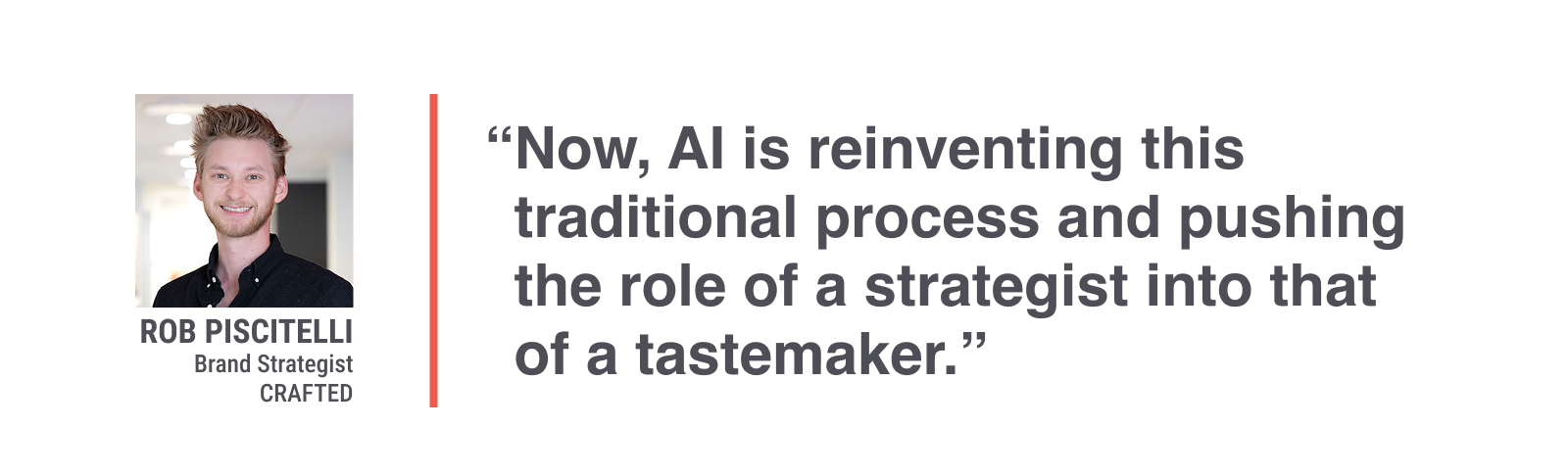
Three weeks of laborious research hunched over a keyboard can now be accomplished in just a few days with supercharged deep analysis, drawing together the full knowledge of a category with a simple, well-directed and thorough prompt. Also gone are the day-to-day tasks of writing the first draft of a brief, building data stories and searching for creative fodder, which are now streamlined with generative AI technology.
Do these disruptive changes spell the end of strategists and their role? Not exactly. Instead, what strategists are experiencing is a shift in what distillation now means. With generative engines pumping out headlines and strategies in seconds, the most important skill is discerning good ads from bad ones. Strong, challenging ideas, not the internet slop and weekly fads. Less foot on the throttle, more finger on the pulse. The tastemaker.
While that is a bit of an oversimplification, tastemakers and strategists have always been similar. In the agency world, strategists lay the foundation of what a brand says, does or the feelings it should evoke. Strategists help brands articulate why they exist and how they fit in the ever-changing cultural swirl.
Because AI tools may scale down the time it takes to conduct research or generate campaign platforms, it’s increasingly critical that strategists also have taste. They must be able to leverage their understanding of culture and context to guide decision-making in an AI-powered world.
Generating disruptive tactics or distinctive social post ideas in mere seconds doesn’t matter if they don’t align with the brand’s vision. Fundamentally, this isn’t all that different from what strategists did in the past. The inputs and timelines may be faster, and the tools may make teams more efficient, but when you look beyond the LLMs and generative tools, the soft skills are the same. It’s just a different kind of distillation.
Rather than refining everything into what really matters, strategists also need to look at everything that’s generated — every blog post, concept idea, headline, research report and feedback — and then identify what’s of quality.
This involves combining a deep understanding of the evolving AI landscape with the brand’s foundational elements. AI iterates on ideas and thinks laterally across prompted categories, then strategists must judge its ideas against our human understanding of the world. Strategists focus far more deeply than before on what audiences care about in their hearts and minds, rather than on market trends. AI might be able to write a tension-filled brief or a campaign, but it can’t judge the writing against the shared feelings of human existence.
The role is shifting to let the machine do the busy work so the strategist can ensure the output is exciting, real, authentic and filled with soul.
Our responsibility hasn’t changed. There’s just an added step — another element — that requires strategists to interpret cultural relevance, spot trends and patterns as they emerge, and identify how they will resonate with audiences. It’s a deeper search for greater meaning, with more clarity over chaos.